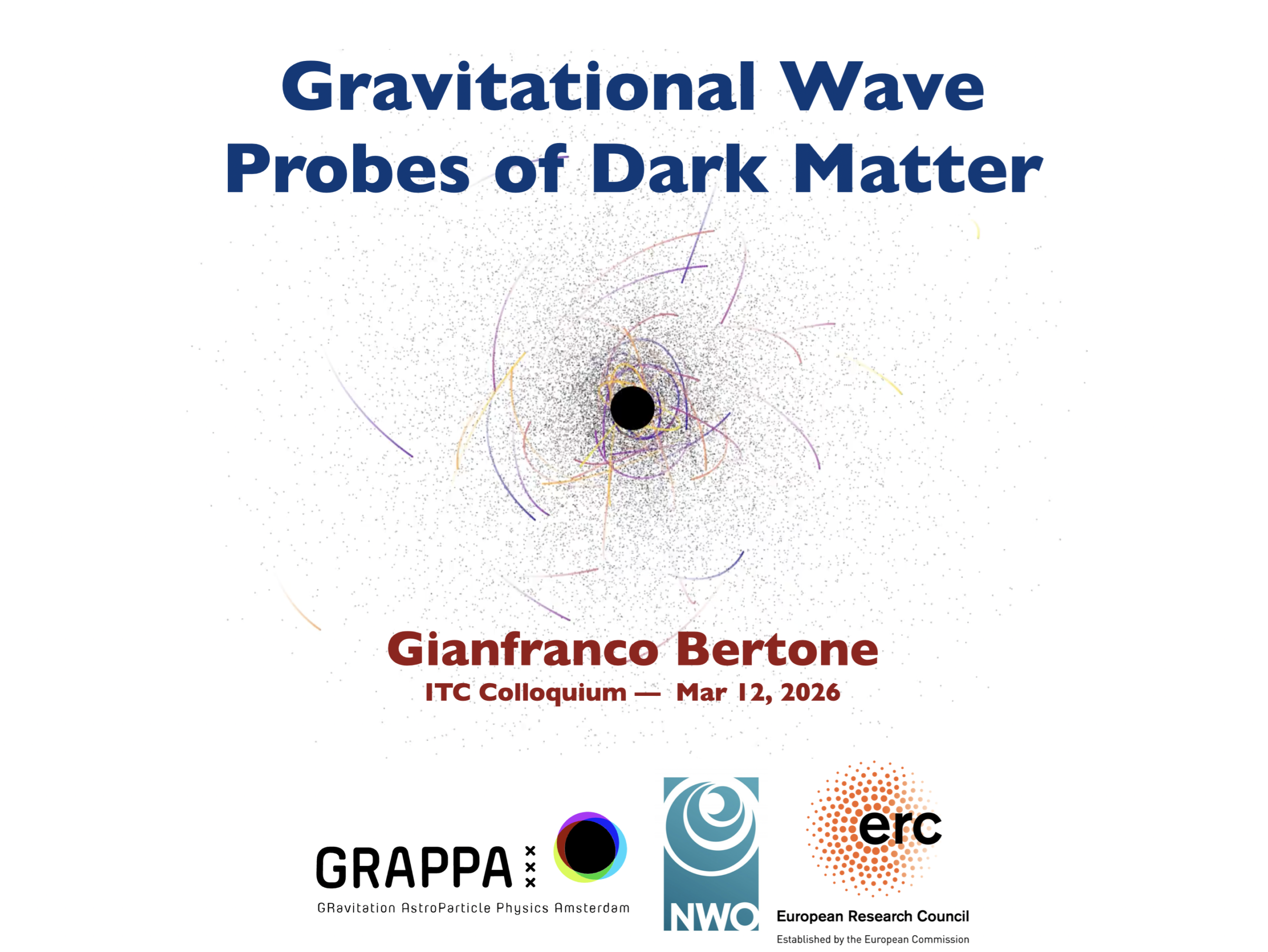
Over the past two weeks I had the pleasure of giving a series of colloquia at RWTH Aachen, U. “La Sapienza” Rome, U. of Zurich, Santa Fe, and ITC Harvard, presenting some recent work on a new and exciting frontier: the use of gravitational waves to probe the nature of dark matter.
The idea is simple. Real black holes do not live in vacuum. They are embedded in environments that may contain gas, stars, and perhaps dense concentrations of dark matter. If those surroundings affect the motion of compact objects spiralling inward, they can leave subtle but potentially measurable imprints on the gravitational-wave signal. With future detectors such as LISA, these effects may come within observational reach.
What makes this direction so interesting is that it adds a new perspective to a very old problem. For decades, dark matter has been pursued through collider experiments, direct detection, and more conventional astrophysical observations. Gravitational-wave astronomy may now offer a different angle: not by looking for dark matter directly in the laboratory, but by using the dynamics of black holes as a way of exploring the dark sector.
This is still a young area, but one that is beginning to gather energy – at the intersection of gravitational-wave physics, cosmology, black-hole astrophysics, and particle theory.
I am very grateful to all the colleagues and hosts in Aachen, Sapienza, UZH, the Santa Fe Institute, and Harvard for the invitations, the hospitality, and the stimulating conversations.
Here is the video of my colloquium at ITC Harvard: