AI can help us publish less

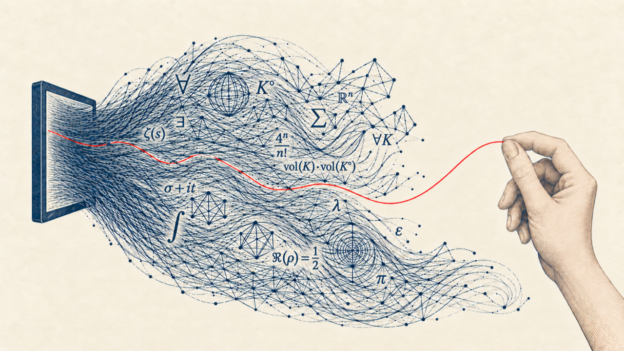
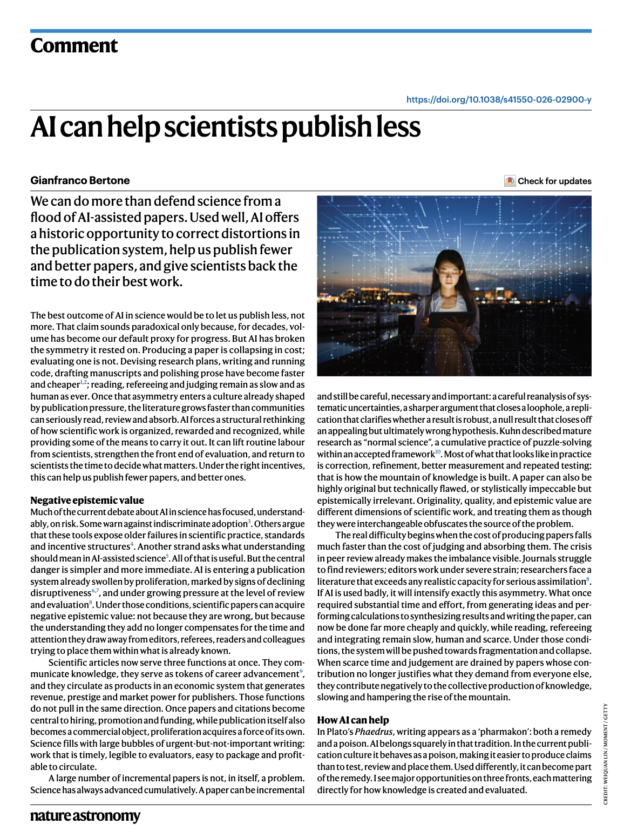
In a Comment published today in Nature Astronomy, I ask whether one of the best uses of AI in science may be to help us publish fewer, better papers.

The title of the piece, “AI can help scientists publish less”, is deliberately provocative. Scientific life is still organized around papers: how many we publish, where we publish them, how often they are cited, how quickly they accumulate into a visible record of activity. But the deeper question raised by AI is not simply whether scientists can now produce more papers. They can. The question is whether producing more papers is what science most needs.

AI is making it cheaper to produce scientific papers. It can help draft text, write code, explore calculations, map literature, polish manuscripts and assemble arguments. Much of this can be useful. Used well, these tools can remove part of the routine labour that consumes scientific time.

But the other side of science has not become cheaper. Reading a paper carefully still takes time. Refereeing it responsibly still takes judgment. Understanding whether a result really adds something to what is already known remains a slow, human, collective task.

This asymmetry may be one of the central challenges AI poses to science.

A paper does not need to be wrong to slow science down. It can be correct, polished and publishable, and still demand more attention from editors, referees, readers and colleagues than the understanding it gives back. In the Comment, I describe this danger as “negative epistemic value”.

The analogy is that of so-called negative-calorie food: food said to require more energy to digest than it provides. Whether or not the nutritional claim is literally true, the metaphor captures something important about scientific publishing. Some papers may cost the community more, in time and attention, than they return in knowledge.

This is not an argument against incremental work. Science has always advanced through correction, refinement, replication, better measurements and careful tests. A paper can be incremental and important. A null result can close a path that needed to be closed. A reanalysis can expose a hidden assumption. A careful technical note can save others years of confusion.

The problem begins when publication becomes the default form into which every contribution must be forced, and when the cost of producing papers falls much faster than the cost of judging and absorbing them.

AI could make this imbalance worse. It could flood an already strained system with more papers: more papers, more claims, more things to review, cite, classify and evaluate.

But this is not the only possible future.

We should aim for more than defending a publication system already under strain from a new technology. We can be bolder, and treat AI as a historic opportunity to correct distortions in the publication system, and to make science, and the lives of scientists, better.

In the Comment, I describe three ways in which AI could help.

First, AI can make more forms of scientific contribution visible: code, data, benchmarks, reproducibility packages, public notebooks, living syntheses. These are already central to how science works, but they often become visible to institutions only when wrapped inside a paper. AI could help make their value legible directly.

Second, AI can reduce some of the routine work that consumes researchers’ time. Literature mapping, documentation, code scaffolding, reproducibility checks, first-pass comparisons across neighbouring fields: none of this replaces scientific judgment, but it can take weight away from the parts of scientific life that have become unnecessarily burdensome.

Third, AI can help editors, referees, panels and funders focus their limited attention where human judgment matters most. It can support triage, literature comparison, consistency checks and the detection of obvious pitfalls. It cannot decide what is important. That remains our responsibility. But it can improve the conditions under which we exercise that responsibility.

The point is not to ask how AI can help us publish more.

The more interesting question is whether AI can help us publish less, and do better science.

That would mean recognizing more kinds of contribution, rewarding responsible publication, and treating fewer, better papers not as a sign of inactivity, but as a mark of maturity. It would mean giving scientists more time to think, more freedom to change direction, and more room for work whose value cannot always be measured by immediate output.

AI will not decide what matters. That remains a human task, and a collective one.

But it may help us recover some of the time, attention and judgment that science needs most.

Comment in Nature Astronomy:
https://www.nature.com/articles/s41550-026-02900-y

Free read-only version:
https://rdcu.be/fnxGo

Colloquia at Aachen / Zurich / Rome / Santa Fe / Harvard

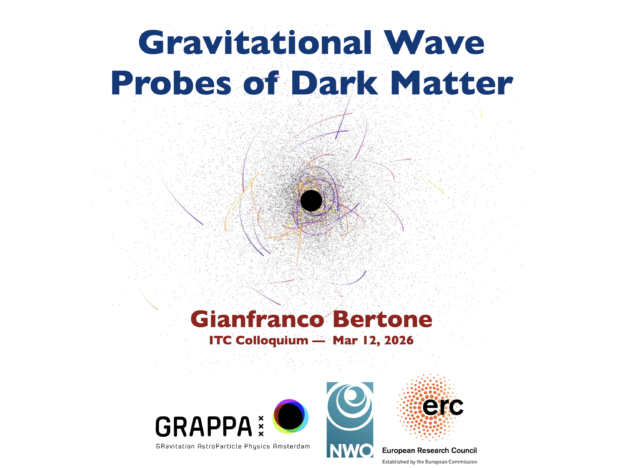
Over the past two weeks I had the pleasure of giving a series of colloquia at RWTH Aachen, U. “La Sapienza” Rome, U. of Zurich, Santa Fe, and ITC Harvard, presenting some recent work on a new and exciting frontier: the use of gravitational waves to probe the nature of dark matter.

The idea is simple. Real black holes do not live in vacuum. They are embedded in environments that may contain gas, stars, and perhaps dense concentrations of dark matter. If those surroundings affect the motion of compact objects spiralling inward, they can leave subtle but potentially measurable imprints on the gravitational-wave signal. With future detectors such as LISA, these effects may come within observational reach.

What makes this direction so interesting is that it adds a new perspective to a very old problem. For decades, dark matter has been pursued through collider experiments, direct detection, and more conventional astrophysical observations. Gravitational-wave astronomy may now offer a different angle: not by looking for dark matter directly in the laboratory, but by using the dynamics of black holes as a way of exploring the dark sector.

This is still a young area, but one that is beginning to gather energy – at the intersection of gravitational-wave physics, cosmology, black-hole astrophysics, and particle theory.

I am very grateful to all the colleagues and hosts in Aachen, Sapienza, UZH, the Santa Fe Institute, and Harvard for the invitations, the hospitality, and the stimulating conversations.

Here is the video of my colloquium at ITC Harvard:

A visit to the Santa Fe Institute

Last week I had the pleasure of visiting the Santa Fe Institute, where I was hosted by Melanie Mitchell, a SFI professor working at the intersection of artificial intelligence, cognitive science, and complex systems, and also a recent finalist of the Cosmos Prize.

The Santa Fe Institute (SFI) is a rather unusual place in the scientific landscape. Founded in the 1980s by a group of physicists, economists and biologists, it was conceived as a space where researchers could explore problems that do not belong neatly to a single discipline. Complexity science is the common language: systems in which many interacting parts produce collective behavior, from biological evolution and ecosystems to markets, social institutions and artificial intelligence.

What makes SFI special is its intellectual atmosphere. People are encouraged to move freely across disciplinary boundaries, asking questions that might sound naïve in a specialized department but that sometimes turn out to be exactly the right ones. Conversations shift between physics, anthropology, computer science, economics and philosophy, and one is constantly reminded that many of the most interesting scientific problems live between fields rather than inside them.

During my visit I gave a seminar on dark matter, focusing on the epistemology of discovery: how scientists infer the existence of invisible phenomena, how competing models evolve, and how the limits of observation shape our understanding of the universe.

But the highlight of the visit was really the opportunity to spend time in individual conversations with SFI scholars.

With Sam Bowles, one of the leading thinkers on the evolution of cooperation and economic behavior, we discussed how institutions can shape human preferences and social norms. We also talked about the deeper political tension this raises: societies depend on norms such as trust, reciprocity and civic responsibility, yet attempts to deliberately cultivate such norms immediately raise fears of social engineering. One of his most striking observations was that institutions influence behavior less through explicit persuasion than through the daily patterns of interaction they create. Interestingly, he also pointed to nationalism, despite its dangers, as historical evidence that human beings are capable of expanding their circle of solidarity far beyond immediate kin or tribe. Can globalism help us do the same across national (and other) boundaries?

With Fred Cooper, our conversation moved in a very different direction. We discussed forms of knowledge that precede conceptualization: ways of engaging with reality that are not primarily analytical. That discussion unexpectedly evolved into a short session of Buddhist meditation exercises, exploring attention and perception as tools for understanding the world before it is framed in concepts.

I also had fascinating discussions with Cris Moore and Melanie Mitchell about the role of artificial intelligence in science and society. One refreshing aspect of these conversations was how quickly the discussion moved beyond the familiar polarized narratives that dominate public debate: the oscillation between technological doom and utopian optimism. When those voices are absent, the discussion becomes far more interesting and nuanced.

With James Holehouse, we discussed the role of regulation in complex systems, from biological organisms to social institutions, as well as the importance of communicating science effectively to the broader public. We also talked about writing for general audiences and the challenges of translating scientific ideas without oversimplifying them.

Finally, I had a stimulating exchange with Marina Dubova about the role of concepts in science. Her work explores a deceptively simple question: what epistemic functions do scientific ontologies actually play? Her answer — which resonates strongly with my own interests — is that scientific concepts are not merely labels for things in the world. They are perspectives that shape every stage of scientific work, from the way data are collected to how results are interpreted and communicated. In that sense, improving scientific concepts cannot be separated from understanding how those concepts have already shaped the scientific process itself.

The visit was also an opportunity to learn more about the history of New Mexico and Santa Fe, including the complex history and present status of Native American communities. Santa Fe itself is a remarkable place: a city where Indigenous traditions, Spanish colonial history, and contemporary culture coexist in a unique way. The local art scene is particularly vibrant, with galleries, museums and public spaces that reflect this rich cultural history.

In the end, what makes the SFI memorable is not (only) the work being done, but the conditions they create for thought. Unstructured interactions, bold questions, and conversations opening freely onto unexpected terrain. The SFI remains one of those rare places where this still happens.

PhD and Postdoctoral Openings

I am delighted to announce the opening of new PhD and Postdoctoral positions in my group, funded by the ERC Advanced Grant “De Tenebris”.

These positions are at the crossroads of general relativity, gravitational wave astrophysics, and dark matter phenomenology, and will be hosted at GRAPPA — the University’s center of excellence in gravitation and astroparticle physics, located at the lively Amsterdam Science Park.

At GRAPPA, you will join a thriving research community with strong connections to major experimental collaborations (including LIGO/Virgo/KAGRA, LISA, Einstein Telescope) and the opportunity to work closely with faculty (S. Ando, D. Baumann, G. Bertone, P. Decowski, B. Freivogel, A. Heijboer, S. Markoff, P. Moesta, S. Nissanke, J. Vink, A. Watts, C. Weniger), postdocs, and students.

🔗 For more information and instructions to apply visit:

The University of Amsterdam is an equal-opportunity employer, committed to building a diverse and inclusive community. We welcome and strongly encourage applications from all qualified candidates.

“100 Years of Quantum Physics” Conference

I just returned from an inspiring conference in Göttingen, organised by the German Physical Society to celebrate 100 years of quantum physics.

It was in the summer of 1925 that Werner Heisenberg, seeking relief from his hay fever on the island of Helgoland, drafted the paper that changed physics forever. Back in Göttingen, together with Max Born and Pascual Jordan, he developed the first mathematical framework of the new theory — known as matrix mechanics — which marked the birth of modern quantum physics.

The conference was a chance to look back at that extraordinary moment in history, but also to see how far the field has come. We heard fascinating talks from Nobel Prize winners and leading scientists — Anton Zeilinger, Serge Haroche, Wojciech Zurek, Klaus von Klitzing, Beate Heinemann, Jürgen Renn and many others — who are pushing the frontiers of quantum physics today. A highlight was a round table I joined with Zeilinger, Zurek and Fröhlich, discussing what quantum physics has taught us — and what mysteries remain.

In my own talk, I spoke about the “quantum roots of the universe”. I began with astronomy as it stood in 1925, when Henrietta Leavitt’s work on Cepheid stars and Edwin Hubble’s discovery of the Andromeda galaxy were just emerging, at the very same time quantum mechanics was being born in Göttingen. From there, I turned to today’s puzzles: dark matter, dark energy, and the Big Bang, and I also showed how future gravitational-wave observatories may help us solve these mysteries. If you’re curious, here are my slides (link to pdf, 8Mb).

The meeting was also the occasion to pay respect to the many great scientists buried in Göttingen. The city’s cemetery is the resting place of nine Nobel laureates and other towering figures, including Max Planck, Max Born, Max von Laue, Karl Schwarzschild, David Hilbert, and many others who shaped the history of modern science.

Another memorable moment was the conference dinner at the historical Gauss Observatory, allegedly built to lure Carl Friedrich Gauss to Göttingen as director. Gauss, later celebrated as the princeps mathematicorum — the prince of mathematicians — made it his scientific home. Dining in that setting was a special way to connect with Göttingen’s outstanding scientific heritage.

A huge thank you to the organisers — Stefan Kehrein, Thomas Weitz, Johanna Stachel and many others — for a wonderful and memorable meeting.