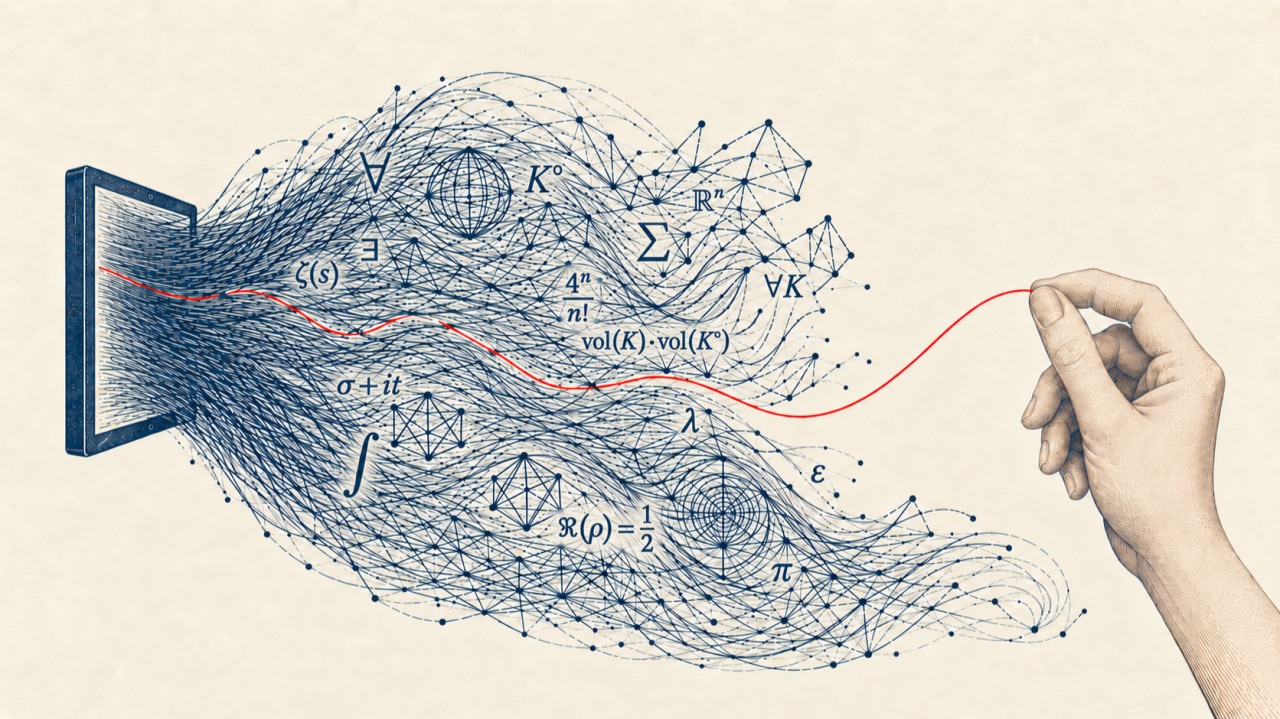
OpenAI released an extraordinary quantity of mathematics this week: 722 manuscripts, grouped into 372 families of results, produced largely by an unreleased AI model that had been given roughly 4,000 open research problems. The catalogue includes claimed solutions to Hilbert’s tenth problem over the rationals, the Unique Games Conjecture and the Mahler conjectures, alongside new results in number theory, theoretical computer science and mathematical physics.
No one yet knows how much of this will stand. Some results have been formalized in Lean, some have not, and OpenAI itself warns that errors may remain. Mathematicians will now have to work through the material. Still, after spending some time with the catalogue, I find it hard to think of this merely as a collection of new theorems. Something is changing in the way mathematics can be produced.
Mathematics has so far escaped much of the logic of mass production. It is still recognizable as a craft. Mathematicians choose problems often for reasons that are difficult to explain to anyone outside the field, and may spend months or years learning how to think about it. Failed attempts are part of the work. New tools are invented because existing ones turn out not to be enough. By the time a proof appears, its authors usually know much more than the sequence of steps needed to establish the theorem. The work produces new points of view.
That link between making something and understanding it was once common in many kinds of work. Industrialization weakened it. A cabinetmaker made a cabinet from beginning to end; a factory divided the same process among machines, specialized workers and managers. Productivity rose dramatically, but the nature of skill changed with it. The person who understood every stage of production was no longer necessarily the person doing the work.
It would be foolish to push the analogy too far, but the OpenAI release has some of the same character. The striking fact is the throughput. OpenAI says that each reported result used, on average, compute equivalent to about three hours of ChatGPT Pro thinking. A research problem that could occupy a mathematician for a year can now, at least in some cases, become one item in a large computational run.
Whether the current results are 30 per cent correct or 90 per cent correct matters greatly for the mathematics. It matters less for this particular observation. Once systems can attack thousands of open problems and return hundreds of serious candidates, mathematical research has acquired a mode of production that did not exist before.
There is a peculiarity here that makes the comparison with ordinary industrialization especially interesting. Factories scale because there is a market for what they produce. If shoes become cheaper to make, more shoes can be sold. The theorem market does not work that way. Once published, a theorem can be used by everyone. There is usually no meaningful way to charge for it, and OpenAI is unlikely to recover the cost of its models by selling solutions to individual conjectures.
So why produce 722 mathematical manuscripts?
Part of the answer is straightforward. Mathematics is an unusually good environment in which to train and test reasoning. It has clear standards of correctness, a deep reservoir of difficult problems and obvious connections to areas such as software verification. There is also, I suspect, a second reason. A hard theorem has value as evidence about the system that found it.
The theorem is the signal: “Look what I can do. I can solve problems that humans have struggled with for decades.”
This matters at a time when AI companies are making increasingly ambitious claims about the capabilities of their models. A solution to a famous problem carries a kind of credibility that a benchmark score does not. If a system can solve a conjecture that specialists have worked on for decades, the result becomes part of the argument that the system is approaching autonomous scientific reasoning, or perhaps something still more general. The mathematics itself may be freely given away because much of the economic value lies in what its production tells us about the machine.
That incentive is not necessarily bad for mathematics. Mathematicians themselves have always been drawn to famous problems, and proving a celebrated theorem has always carried reputational value. But an AI laboratory has different reasons for choosing problems. Questions that make good demonstrations of capability may receive attention out of proportion to questions that are more fertile mathematically but harder to explain in a press release or a benchmark table. If theorem production becomes cheap enough, those choices could start influencing the direction of research.
The ownership structure also looks odd. The results are released into a public discipline, while the system capable of producing them remains private. Mathematicians can inspect the manuscripts, try to understand the proofs and build on whatever turns out to be useful, but they cannot take the same model and ask the next question. For now, one side chooses the problems and operates the machinery; the wider community receives the output.
The Lean formalizations released alongside the manuscripts suggest that correctness checking may itself become scalable. That would be an extraordinary achievement. But knowing that a proof is valid is not the same as knowing what one has learned from it.
Historically, the difficult part was producing new results. We may now have the opposite problem: results can be generated in such numbers that the scarce resource becomes the human attention needed to check and understand them. Formal verification can establish that a proof is correct, but it cannot by itself tell us whether a result opens a new direction or reveals a deeper structure.
The Advisory Group on Mathematics and Artificial Intelligence has raised a related concern. Mathematicians, it argues, should remain able to formulate their own questions and pursue directions that are not selected by AI laboratories as demonstrations of their systems. Access matters for the same reason. A community cannot fully determine its own research programme if the most powerful instrument available to it belongs to someone else.
There is an unappealing version of the future in which a few companies generate mathematics at enormous speed and professional mathematicians spend increasing amounts of time sorting through what arrives. But it doesn’t have to be this way and, in fact, it may not even be the most likely outcome. The more interesting possibility is to put the machinery in the hands of mathematicians and see how their ambitions change.
Jeremy Avigad recently argued on Terence Tao’s blog that the response should be, in effect, to “solve harder problems, think bigger thoughts, and try new things.” I find that more compelling than trying to preserve the present division of intellectual labour. If AI makes a class of problems dramatically easier, the interesting question is what mathematicians will attempt once they are no longer spending most of their time overcoming those particular obstacles.
A researcher who can send fifty approaches down different paths, ask for counterexamples overnight, formalize a tentative argument while continuing to work on the conceptual problem, and explore calculations that would previously have consumed six months is doing something different from either a traditional mathematician or an autonomous AI system. We might call it AI-augmented mathematics. It will be interesting to see what mathematicians choose to do when ideas that once took months or years to explore can be pursued in minutes or hours.
My guess is that the valuable human contribution will move upward. Mathematical taste has always mattered: the sense that one question is worth ten others, that an odd calculation is hiding a simpler principle, that two remote subjects are somehow talking about the same thing. Those judgments are difficult to encode in a benchmark because we often recognize their value only after they have changed the field. They are also where a great deal of the pleasure of doing mathematics resides.
This is why the public character of mathematics and the private character of the new AI systems sit uneasily together. The goals of OpenAI and other AI companies and the goals of mathematics overlap, but they are not identical. For an AI company, solving a famous conjecture may be evidence of progress toward a much larger technological goal. For a mathematician, the same conjecture may matter because the attempt to solve it generates a new language, exposes an unexpected connection or teaches us that we have been asking the wrong question.
The best outcome I can imagine is a form of collaboration in which mathematicians can use systems of this power to go after questions they themselves consider important, including questions that no AI company would ever choose as a demonstration. If that becomes possible, the analogy with industrialization changes. The machine does not merely manufacture existing goods more cheaply; it gives its users access to regions of intellectual space they could not previously reach.
We are not there yet. This week’s release is impressive partly because it makes the distance visible. We have a system producing mathematics at a scale no human researcher could match, but we still have only a sketch of the institutions, norms and working practices needed to use such systems well.
That seems to me the real issue raised by the OpenAI release. The question of whether AI can produce serious mathematics is becoming less interesting by the day. What matters now is who will decide what this new capacity is used for, and whether mathematicians themselves will have enough freedom to discover what they can do with it.
This article was originally published on LinkedIn.