
From October 2009 to September 2010 I will be a Visiting Professor at the Insitute for Theoretical Physics of the University of Zurich, on leave from IAP in Paris.
From October 2009 to September 2010 I will be a Visiting Professor at the Insitute for Theoretical Physics of the University of Zurich, on leave from IAP in Paris.
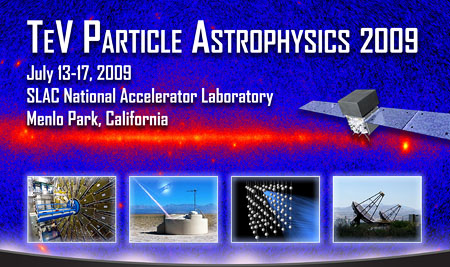
The 2009 edition of the TeV Particle Astrophysics conference is about to start (welcome talk on Monday morning, at 8.30am, in the Panofsky auditorium at SLAC). About 200 scientists have already registered for this event, that aims at bringing together theorists and experimentalists, to discuss the present and the future of Particle Astrophysics at the TeV scale (and above). Here is the description of the conference, from the TeVPA’09 website.
Particle astrophysics is now a busy intersection between particle physics, astrophysics and cosmology. In 2009, the Large Hadron Collider will begin taking data and start its exploration of the TeV scale and physics beyond the Standard Model. The Fermi Gamma-ray Space Telescope (FGST) launched in June 2008, and it will have passed its one year anniversary by the time of the conference. Many results have already been reported, and there will be considerably more by the time of the conference. We expect more interesting results from Pamela and ATIC. In addition, ground-based gamma ray telescopes including HESS, MAGIC, VERITAS, MILAGRO and ARGO have been observing gamma-rays at the TeV scale and higher with unprecedented accuracy for years. We also expect new exciting results from Auger. Neutrino experiments such as Antares and IceCube are starting to run at similar and higher energies. Underground experiments that focus on dark matter direct detection, neutrino mass measurement, and gravitational wave detection, are all making rapid progress. This conference aims to understand what we can learn from the present and upcoming observational results from both the LHC and a broad range of astrophysical searches. It will provide an occasion for theorists and experimentalists to discuss the latest and upcoming results in these fields, to consider new strategies, technologies and collaborative efforts to address some of the most pressing questions in physics today, including the nature of dark matter and the origin of cosmic rays.
 Dr. Steven Chu, 1997 Nobel Laureate in Physics and 12th Secretary of Energy of the United States (appointed by president-elect Obama shortly after his election) gave a lecture here at SLAC this morning.
You can get a fair idea of the contents of the lecture (jokes included) by watching this video (2007)
http://gustavus.edu/events/nobelconference/2007/chu-lecture.php
It would be difficult to briefly summarize his 1-1/2 hour talk, but one of the key messages was: because of climate change the planet is not in good shape, and we have to act quickly to avoid more serious problems. Chu proposes to take a bold and pragmatic approach to the problem, ranging from do-it-yourself solutions (paint you rooftop white!), to new regulations that promote “green” behaviors.
Whether this approach succeeds or not, he gave the impression to be the right person for the job. Smart people in strategic position: isn’t that a great idea?
PS: check out the Symmetry Breaking article on this event here.

Taking a break from the parisian “grisaille”, I am currently visiting KIPAC and Stanford U. for a month. These two institutions, among other things, play a major role in the Fermi satellite collaboration, currently collecting very interesting data on high energy astrophysical phenomena.
There’s an incredible concentration of activities in Particle Astrophysics between SLAC and the Stanford U., and three weeks from now the 5th edition of the TeVPA’09 conference will take place right here.
 The rise in the energy spectrum of the positron ratio, observed by the PAMELA satellite above 10 GeV, and other cosmic ray measurements, have been interpreted as a possible signature of Dark Matter annihilation in the Galaxy. However, the large number of free parameters, and the large astrophysical uncertainties, make it difficult to do conclusive statements about the viability of this scenario. In a recent paper, Miguel Pato (PhD student at IAP), Lidia Pieri (postdoc at IAP) and I have performed a multi-wavelength, multi-messenger analysis, that combines in a consistent way the constraints arising from different astrophysical observations. We have shown that if standard assumptions are made for the distribution of Dark Matter (we build models on the recent Via Lactea II and Aquarius simulations) and the propagation of cosmic rays, current DM models cannot explain the observed positron flux without exceeding the observed fluxes of antiprotons or gamma-ray and radio photons. To visualize the multi-messenger constraints, we have introduced “star plots”, a graphical method that allows to show in the same plot theoretical predictions and observational constraints for different messengers and wavelengths.