GRAPPA (Gravitation and AstroParticle Physics Amsterdam) is the name of the new center of excellence of the University of Amsterdam. In an unprecedented effort, the University hired 4 new professors in 2011 (Shin’Ichiro Ando, Patrick Decowski, Ben Freivogel and myself) and two additional positions will be opened at the end of the year. There will be a kick-off meeting this Fall, stay tuned!
Author Archives: gf.bertone@gmail.com
ERC Starting Grant
The proposal “WIMPs Kairos – The Moment of Truth for WIMP dark matter” has been placed in the priority list by a panel of experts of the European Research Council, and it will be funded under the “ERC Starting Independent Researcher Grant” scheme. The scope of this line of research is described in the proposal’s incipit:
Identifying Dark Matter is a top priority in Particle Physics and Cosmology: we know it contributes 85% of all the matter in the Universe, and we know that it cannot be made of ordinary baryonic matter. What is it then? Among Dark Matter candidates, WIMPs (weakly interacting massive particles) occupy a special place, since they naturally arise from well motivated extensions of the standard model of particle physics, therefore providing an elegant explanation to the Dark Matter problem. With the advent of the Large Hadron Collider at CERN, and of a new generation of astroparticle experiments, the moment of truth has come for WIMPs, for we will either discover them in the next 5 to 10 years, or we will inevitably witness the decline of the WIMP paradigm.
No WIMPs yet (and no HE neutrinos either)
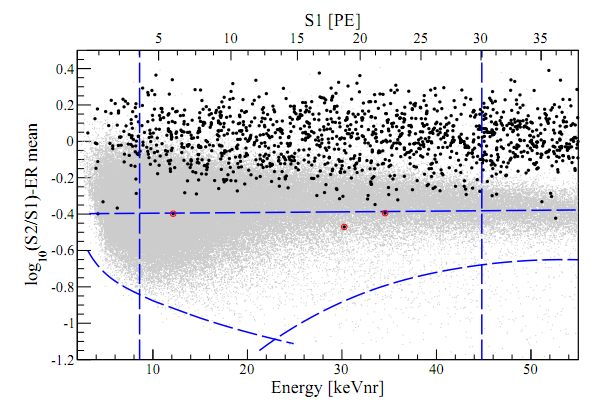
There were big expectations for Xenon 100, a leading experiment in the race for the direct detection of Dark Matter. But the results announced today are somewhat disappointing, since the collaboration announced the detection of 3 events, while the expected background is of 1.8±0.6 events. (see also the discussion at Resonaances).
Should we panic? Not yet, in my opinion. As argued elsewhere, the best we can do is to stick to our plans, and see what ton-scale experiments (and the LHC) will tell us, before drawing our conclusions about WIMP Dark Matter.
New results of the neutrino telescope IceCube have also been published recently (see here and here). As the collaboration acknowledges: “The results from all searches are compatible with a fluctuation of the background”, which means that no point sources have been detected.
Space traffic jam: AMS-02 launch postponed to April 29
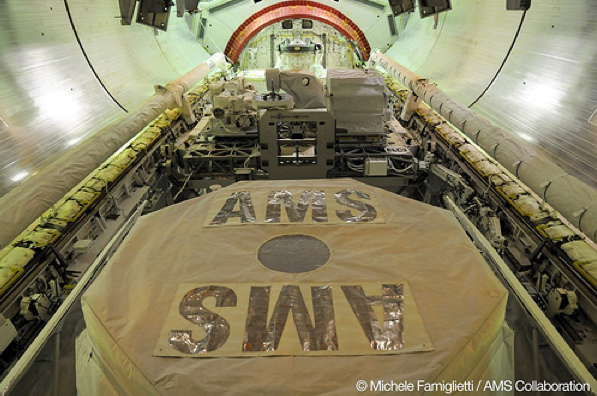
The launch date of the Alpha Magnetic Spectrometer AMS-02 (“-02” because it is the successor of first AMS experiment, flown into space in June 1998) has been postponed to April 29 (above, an image of AMS-02 in the bay of the Shuttle Endeavor).
The delay is not due to the severe weather conditions of the past week, that produced only “very minor” damage, but to a conflict with the docking operations of the Progress M-10M cargo ship, a russian vehicle that will deliver up to 2.5 t of propellant, scientific equipment, food, air, water, etc. to the International Space Station (ISS), scheduled for launch on April 27 from the Baikonur Space Center in Kazakhstan.
Apparently, the problem comes from the time-sensitive nature of the Progress cargo, a biological experiment which needs to be placed into one of the ISS’ freezers within days of launch..
Although postponing the launch by 10 days is not dramatic per se, the launch date is getting uncomfortably close to the end of the launch window (see here a description of how it is determined).