Author Archives: gf.bertone@gmail.com
More surprises from PAMELA

The PAMELA satellite has been launched in 2006 and since then it has held many surprises. Back in 2008, the PAMELA collaboration found an anomalous cosmic positron abundance, which prompted the publication of hundreds of papers (690 citations to the original paper as of March 8, 2011).
Last week, the collaboration has published on ‘Science Express‘ the measurement of proton and Helium spectra in the rigidity range 1 GV – 1.2 TV (see figure above). The shape of these spectra deviate significantly from the simple power-law behavior predicted by the current paradigm (see e.g. this review paper), which posits that cosmic rays in this energy range are accelerated in supernova remnants.
Interestingly, the deviations from the predictions are different from protons and He nuclei, a feature that is difficult to accomodate even in the most sophisticated models of acceleration.
In short, this means that we are probably seeing the effect of new sources of cosmic rays (in the paper the authors cite e.g. this study of a multi-component population of cosmic rays).
Convincing proof of extraterrestrial life?
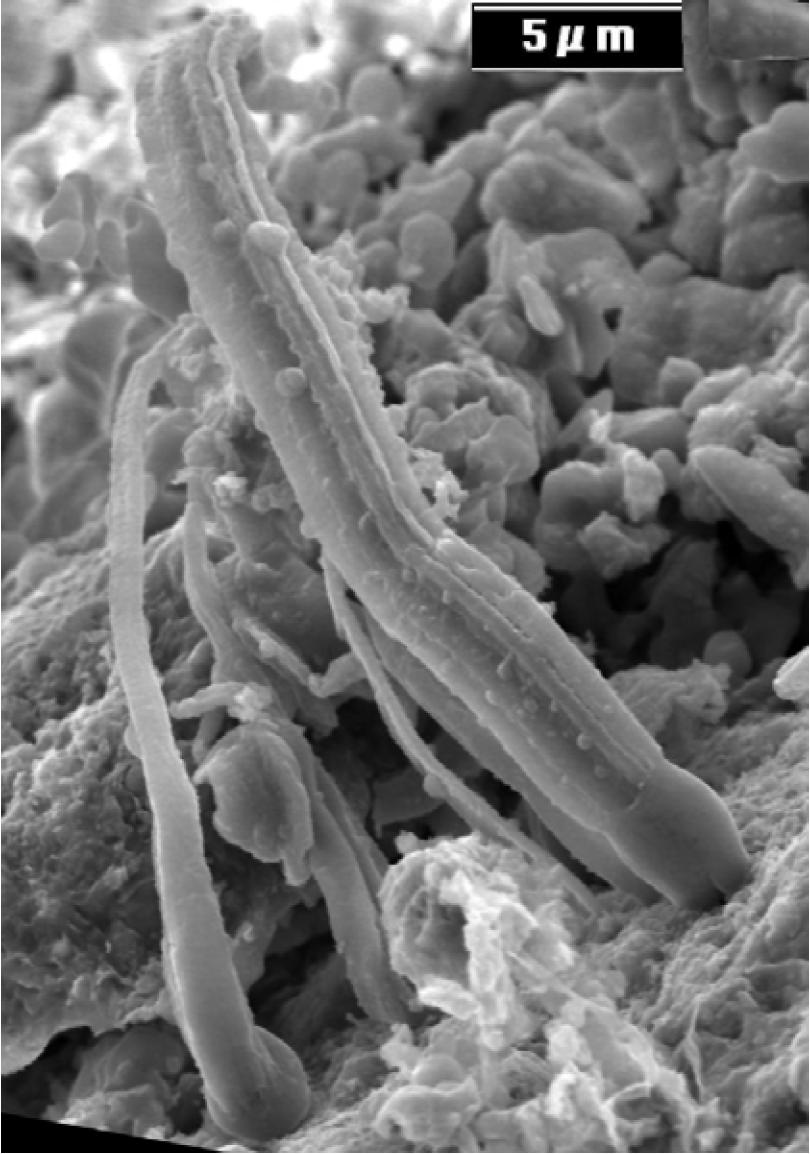
On March 2, the Journal of Cosmology has sent an invitation to send a 1000 words commentary on a paper of R. Hoover (go there only if you are interested, as they’ll try to redirect you to the Amazon.com page of a book edited by Hoover. Very, very bad!), claiming the discovery of indigeneous microfossils in the interior of some meteorites, similar to fossilized Earth bacteria. The key-word in the sentence above is “indigenous”, since it implies that these microfossils represent the remains of bacteria which lived outside the Earth.
Now, I found it rather bizarre that a journal requests a 1000 words commentary to anyone in the scientific community is willing to say something. They even specify:
Commentaries may focus entirely on Dr. Hoover’s paper, or you may speculate about the implications, e.g, the evolution of life on other planets, the origin of life on Earth, our genetic ancestry, “are we alone?” etc.
Oh, well. And to be honest, given the comments that actually appeared on the webpage of the Journal, I’d be surprised if they were actually peer-reviewed at all (as claimed by the editors).
Despite the premises, I tried to develop an informed opinion, to answer the questions of friends and family who read about the news everywhere on the web. After reading about it here, here, here and here, I am tempted to say that the claim is far from robust, and, to say the least, it should be taken with a huge grain of salt.
Do we
Abstract: Protons and helium nuclei are the most abundant components of the cosmic radiation. Precise measurements of their fluxes are needed to understand the acceleration and subsequent propagation of cosmic rays in the Galaxy. We report precision measurements of the proton and helium spectra in the rigidity range 1 GV-1.2 TV performed by the satellite-borne experiment PAMELA. We find that the spectral shapes of these two species are different and cannot be well described by a single power law. These data challenge the current paradigm of cosmic-ray acceleration in supernova remnants followed by diffusive propagation in the Galaxy. More complex processes of acceleration and propagation of cosmic rays are required to explain the spectral structures observed in our data.