Author Archives: gf.bertone@gmail.com

LHC early constraints on SUSY

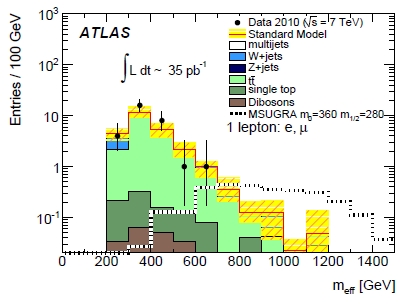
The first analyses of the impact of early LHC data on the parameter space of Supersymmetry (SUSY) have been presented at several winter conferences.

The results the ATLAS and CMS papers have been recently posted on the arXiv (here and here), and they are actually based on 35 pb-1 of LHC data at 7 TeV.

A good discussion of their impact on SUSY can be found in the blogosphere at Resonaances and in Tommaso Dorigo’s blog. For technical discussions see also the papers of A. Strumia and B. Allanach.

Looks like the moment of truth is coming for SUSY, and more in general for WIMP Dark Matter.

2011 Europhysics Conference on High Energy Physics

This summer Ralph Engel (KIT-Karlsruhe), Patrick Dekowski (NIKHEF) and I will act as conveners for the parallel session “Astroparticle Physics” of the 2011 Europhysics Conference on High Energy Physics, organized by the European Physical Society’s High Energy Particle Physics Division Board. The Conference will take place in the charming city of Grenoble, from July 21 to 27, 2011. 

Solar Sail Stunner

From NASA Science News :

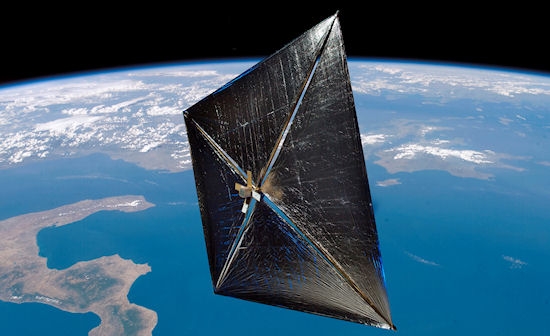
In an unexpected reversal of fortune, NASA’s NanoSail-D spacecraft has unfurled a gleaming sheet of space-age fabric 650 km above Earth, becoming the first-ever solar sail to circle our planet.
“We’re solar sailing!” says NanoSail-D principal investigator Dean Alhorn of the Marshall Space Flight Center in Huntsville, AL. “This is a momentous achievement.”
Read more here..

Mt. Etna erupts

Directly from Bad Astronomy, gorgeous images of Mt Etna (and other volcanoes) as seen from space. As a kid I used to watch Etna’s eruptions “live” from the windows of our home in Reggio Calabria.

There are a handful of volcanoes in the world that evoke an immediate recognition, dormant or not. Vesuvius, Krakatoa, Mt. St. Helens. Certainly, Sicily’s Mt. Etna is another. At 3300 meters in elevation, it’s the largest active volcano in Italy… and by active, I do mean active.

In 2002, Etna erupted in a relatively large display of lava and ash. This view was taken by Expedition 5 about the International Space Station, looking southeast at a low angle. This eruption let loose a river of lava down the flank of the volcano which set fire to pine trees there; the dark plume is from the eruption, but the whiter ones are from burning pine trees. The plume from this eruption blew south and was reported as far away as Libya, nearly 600 km distant.

Unlike Earth observing satellites, which point straight down, astronauts on the ISS have the luxury of seeing things at an angle, providing a more natural – and in this case, more spectacular – view to our human eyes and brain.


http://blogs.discovermagazine.com/badastronomy/2011/01/20/mt-etna-erupts/