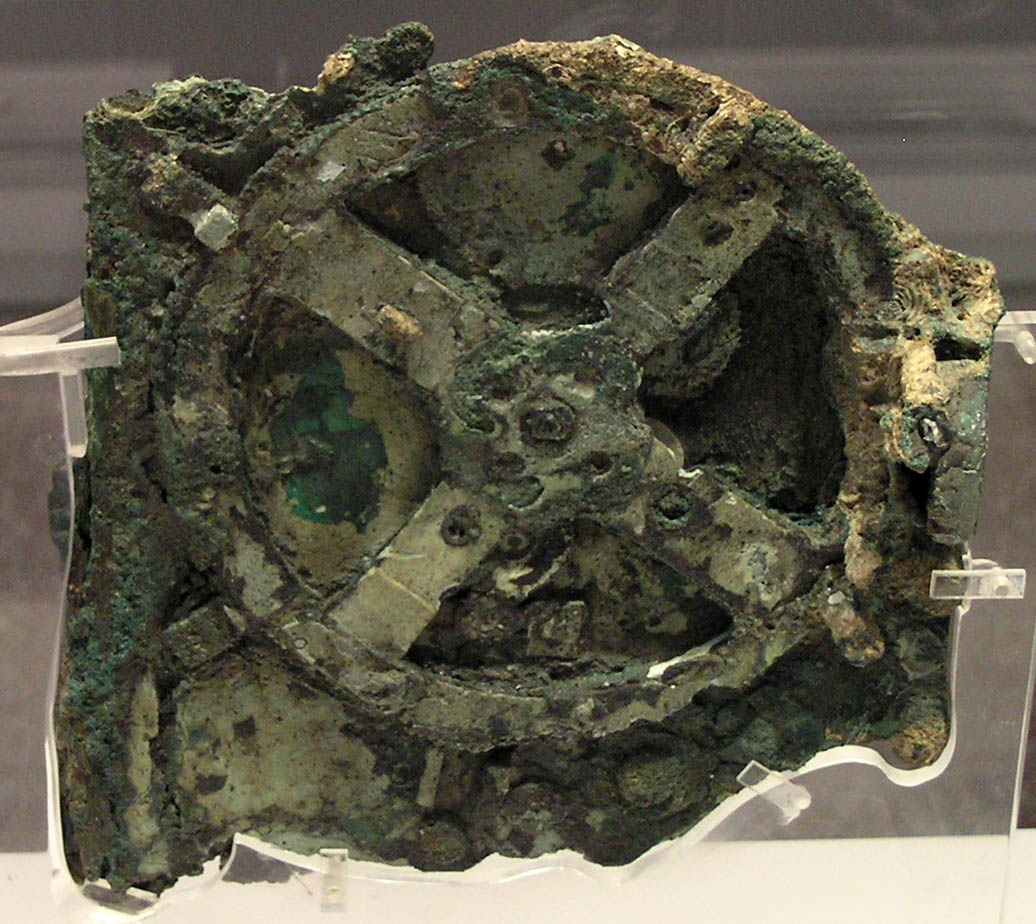
Can you guess what the mechanism above is?
Answer (directly from Wikipedia): Antikythera mechanism fragment. The mechanism consists of a complex system of 32 wheels and plates with inscriptions relating to the signs of the zodiac and the months. The study of the fragments suggests that this was a kind of astrolabe used for marine navigation. The interpretation now generally accepted dates back to studies by Professor Derek de Solla Price, who was the first to suggest that the mechanism is a machine to calculate the solar and lunar calendar, that is to say, an ingenious machine to determine the time based on the movements of the sun and moon, their relationship (eclipses) and the movements of other stars and planets known at that time. The mechanism was probably built by an ingenious mechanic school Posidonius in Rhodes. Cicero, who visited the island in a. 79/78 C. reported that such devices were indeed designed by the Stoic philosopher Posidonius of Apamea. The design of the Antikythera mechanism appears to follow the tradition of Archimedes’ planetarium, and may be related to sundials. His modus operandi is based on the use of gears. The machine is dated 89 a. C. around and comes from the wreck found off the island of Antikythera. National Archaeological Museum, Athens, No. 15987.
Author Archives: gf.bertone@gmail.com
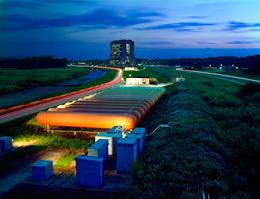
Fermilab: Tevatron shut down in 2011
A message from Fermilab’s director Piero Oddone, appeared on “Fermilab Today” (see also this Nature article):
Yesterday we received the news that we will not receive funding for the proposed Tevatron extension and consequently the Tevatron will close at the end of FY2011 as was previously planned. The present budgetary climate did not permit the DOE to secure the additional funds needed to run the Tevatron for three more years as recommended by the High Energy Physics Advisory Panel. Both Tevatron collaborations did a splendid job articulating the physics case and all the relevant issues to both our Physics Advisory Committee and the national advisory committees, which led to the recommendation to extend the Tevatron.
We plan to extract every bit of physics we can from this final Tevatron running period. The Tevatron has already exceeded all expectations, and given the large datasets we will continue to find new results and discoveries in the Tevatron data for years to come. The life of this legendary machine has been marked by historic discoveries made possible by its innovative accelerator and detector technologies. The experience gained during its operation has also immensely helped the development of the LHC accelerator and detectors. Fermilab is and will remain a very strong part of the LHC program and will continue to pursue physics at the high-energy frontier together with our collaborators at CERN.
As you can imagine I have answered many questions from the press over the last 24 hours. They are interested in the future of Fermilab, what may happen with jobs on our site and whether or not there will be any layoffs. There are about 100 jobs connected with the operations and maintenance of the colliding beam program. At this point the situation is very fluid because we do not have all the information we need to make decisions. In particular:
- a) We do not know the budget for FY11 since we are in a Continuing Resolution and Congress has not acted on any of the appropriations bills.
- b) We do not know the President’s budget request for the following year, FY12. We will know this only in mid February.
When the Tevatron concludes operations, we plan to move as many employees as possible to jobs on several new experiments and projects, many of which are already well underway and in need of extra help. Of course, this depends on the budget for FY11 and FY12 and on how fast the new projects ramp up. It will be a complex transition for the laboratory, and soon we will set up a Q&A website to answer questions about the issues that this transition entails.
The Office of Science and Fermilab are committed to maintaining our laboratory as a world leader for particle physics research. We have the Office of Science’s strong support to develop into the foremost laboratory at the Intensity Frontier with new neutrino experiments NOvA, MicroBooNE and the Long Baseline Neutrino Experiment (LBNE); the muon-to-electron conversion experiment (Mu2e); and ongoing experiments MINOS, MINERvA and MiniBooNE. Underlying our Intensity Frontier program we have the Office of Science’s support for the development of Project X. In addition we have leading programs at the Cosmic Frontier with the Dark Energy Survey, the dark-matter experiments CDMS and COUPP, and Pierre Auger. While we would have liked to run the Tevatron for three more years, our life going forward is full of promising projects and great opportunities for major discoveries.
Ngram Dark Matter
Complementarity of Dark Matter Direct Detection Targets
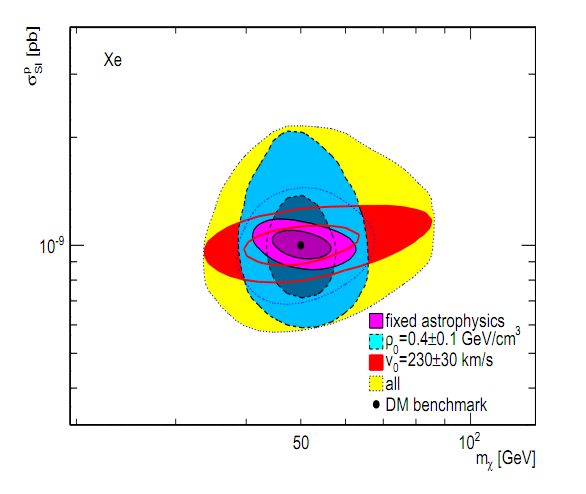
We (i.e. Miguel Pato, Laura Baudis, Roberto Ruiz de Austri, Louie Strigari, Roberto Trotta, and myself) have posted a new paper on the arXiv today, that deals with the complementarity of different Dark Matter direct detection targets. In this paper, we investigate the reconstruction capabilities of Dark Matter mass and spin-independent cross-section from future ton-scale direct detection experiments using germanium, xenon or argon as targets. Adopting realistic values for the exposure, energy threshold and resolution of Dark Matter experiments which will come online within 5 to 10 years, the degree of complementarity between different targets is quantified. We investigate how the uncertainty in the astrophysical parameters controlling the local Dark Matter density and velocity distribution affects the reconstruction. For a 50 GeV WIMP, astrophysical uncertainties degrade the accuracy in the mass reconstruction by up to a factor of $\sim 4$ for xenon and germanium, compared to the case when astrophysical quantities are fixed. However, combination of argon, germanium and xenon data increases the constraining power by a factor of $\sim 2$ compared to germanium or xenon alone. We show that future direct detection experiments can achieve self-calibration of some astrophysical parameters, and they will be able to constrain the WIMP mass with only very weak external astrophysical constraints.
The abstract can be found here, or you can directly download the PDF.
Dark Matter All Around – Paris, 13-15 December 2010
A focus workshop on Dark Matter detection phenomenology will take place at the Institut d’Astrophysique de Paris, from December 13 to 15, 2010. More information here.