TVE Cantabria included in the news a reference to the 2nd MultiDark Consolider Workshop (check out the video at min. 14:00). Includes interviews to Sven Heinemeyer and Carlos Munoz.
Author Archives: gf.bertone@gmail.com
Local dark matter density
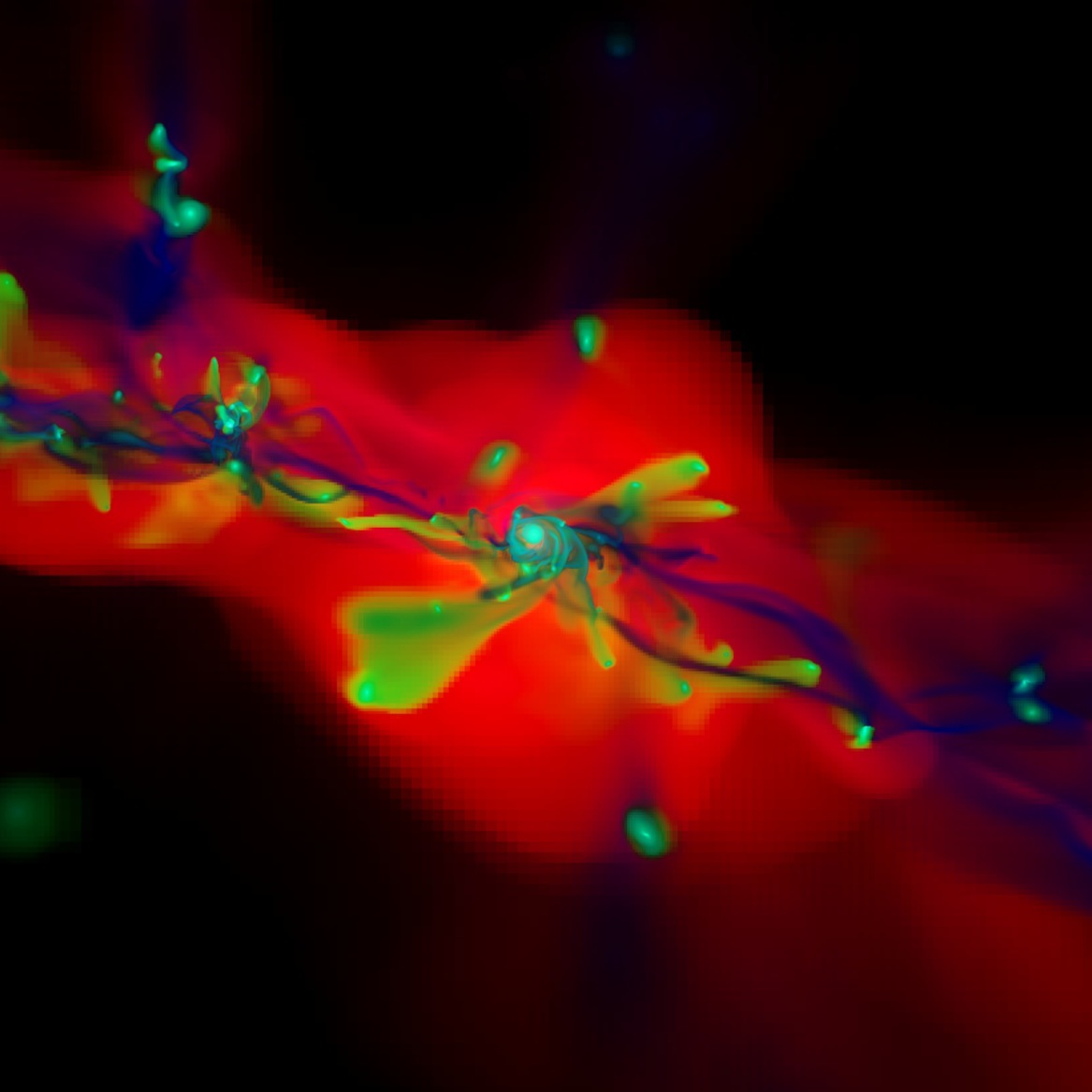
A precise determination of the local dark matter density and an accurate control over the corresponding uncertainties are of paramount importance for Dark Matter (DM) searches. Using very recent high-resolution numerical simulations of a Milky Way like object, we have studied the systematic uncertainties that affect the determination of the local dark matter density based on dynamical measurements in the Galaxy. In particular, extracting from the simulation with baryons the orientation of the Galactic stellar disk with respect to the DM distribution, we have studied the DM density for an observer located at $\sim$8 kpc from the Galactic center {\it on the stellar disk}, $\rho_0$. This quantity was found to be always larger than the average density in a spherical shell of same radius $\bar{\rho}_0$, which is the quantity inferred from dynamical measurements in the Galaxy, and to vary in the range $\rho_0/\bar{\rho}_0=1.01-1.41$. This implies that the actual dark matter density in the solar neighborhood is on average 21% larger than the value inferred from most dynamical measurements, and that the associated systematic errors are larger than the statistical errors recently discussed in the literature. The full paper can be found at
(copyright image O. Agertz http://www-theorie.physik.unizh.ch/~agertz)
Effect of light Dark Matter particles on the Sun

We have recently posted a new paper on the arXiv, on the effect of dark matter (DM) particles in the Sun, focusing in particular on the possible reduction of the solar neutrinos flux due to the energy carried away by DM particles from the innermost regions of the Sun, and to the consequent reduction of the temperature of the solar core.
We found that in the very low-mass range between 4 and 10 GeV, recently advocated to explain the findings of the DAMA and CoGent experiments, the effects on neutrino fluxes are detectable only for DM models with very small, or vanishing, self-annihilation cross section, such as the so-called asymmetric DM models. The figure on the left shows the combination of DM masses and Spin Dependent cross sections which can be excluded with current solar neutrino data.
Our paper can be downlaoded at
Other recent papers on the same subject include
and
Identification of Dark Matter particles with LHC and direct detection data

Dark matter is currently searched for with a variety of detection strategies. Accelerator searches are particularly promising, but even if Weakly Interacting Massive Particles (WIMPs) are found at the Large Hadron Collider (LHC), it will be difficult to prove that they constitute the bulk of the DM in the Universe. We have recently posted a new paper on the arXiv
where we show that a significantly better reconstruction of the DM properties can be obtained with a combined analysis of LHC and direct detection (DD) data, by making a simple Ansatz on the WIMP local density, i.e. by assuming that the local density scales with the cosmological relic abundance. Our results show that future ton-scale DD experiments will allow to break degeneracies in the SUSY parameter space and achieve a significantly better reconstruction of the neutralino composition and its relic density than with LHC data alone.
"Particle Dark Matter" Book is out!
 The book “Particle Dark Matter: Observations, Models and Searches” (Cambridge University Press, ed. G. Bertone) is now out!
Aimed at graduate students and researchers, this book describes the theoretical and experimental aspects of the dark matter problem in particle physics, astrophysics and cosmology. Featuring contributions from 48 leading theorists and experimentalists, it presents many aspects, from astrophysical observations to particle physics candidates, and from the prospects for detection at colliders to direct and indirect searches. The book introduces observational evidence for dark matter along with a detailed discussion of the state-of-the-art of numerical simulations and alternative explanations in terms of modified gravity. It then moves on to the candidates arising from theories beyond the Standard Model of particle physics, and to the prospects for detection at accelerators. It concludes by looking at direct and indirect dark matter searches, and the prospects for detecting the particle nature of dark matter with astrophysical experiments.
For more information please visit the website of the book