Author Archives: gf.bertone@gmail.com
Anisotropy and Energy Spectrum of the CGB
 The meeting on the Anisotropy and Energy Spectrum of the CGB has been a lot of fun, and very fruitful indeed.
In this picture, a brainstorming session during a sunny afternoon in Zurich. From left to right: Tim Linden, Alessandro Cuoco, Vaso Pavlidou, Jennifer Siegal-Gaskins, Fabio Iocco, Lidia Pieri, Mattia Fornasa and Enzo Branchini.
The results of our work will appear, in the form of a series of papers from different sets of authors, on the arXiv over the next few months. Stay tuned!
ɣ in Z Workshop @ ITP Zurich, Nov 16 to 20, 2009

The workshop ɣ in Z will take place at ITP Zurich from November 16 to 20, 2009. It consists of a week long collaboration meeting in the framework of a Fermi guest investigator grant titled “Anisotropy and energy spectrum of the Gamma-ray Background as probes of Dark Matter and Astrophysical sources”, and of a one-day workshop, on Wednesday 18. More information can be found at http://www2.iap.fr/users/bertone/GinZ.
Visiting Professor @ ITP Zurich

From October 2009 to September 2010 I will be a Visiting Professor at the Insitute for Theoretical Physics of the University of Zurich, on leave from IAP in Paris.
TeV Particle Astrophysics 2009
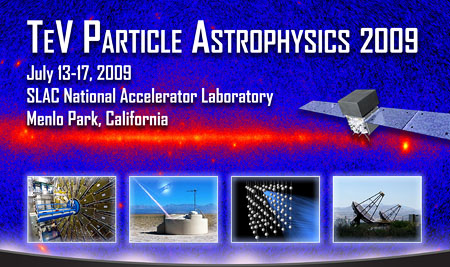
The 2009 edition of the TeV Particle Astrophysics conference is about to start (welcome talk on Monday morning, at 8.30am, in the Panofsky auditorium at SLAC). About 200 scientists have already registered for this event, that aims at bringing together theorists and experimentalists, to discuss the present and the future of Particle Astrophysics at the TeV scale (and above). Here is the description of the conference, from the TeVPA’09 website.
Particle astrophysics is now a busy intersection between particle physics, astrophysics and cosmology. In 2009, the Large Hadron Collider will begin taking data and start its exploration of the TeV scale and physics beyond the Standard Model. The Fermi Gamma-ray Space Telescope (FGST) launched in June 2008, and it will have passed its one year anniversary by the time of the conference. Many results have already been reported, and there will be considerably more by the time of the conference. We expect more interesting results from Pamela and ATIC. In addition, ground-based gamma ray telescopes including HESS, MAGIC, VERITAS, MILAGRO and ARGO have been observing gamma-rays at the TeV scale and higher with unprecedented accuracy for years. We also expect new exciting results from Auger. Neutrino experiments such as Antares and IceCube are starting to run at similar and higher energies. Underground experiments that focus on dark matter direct detection, neutrino mass measurement, and gravitational wave detection, are all making rapid progress. This conference aims to understand what we can learn from the present and upcoming observational results from both the LHC and a broad range of astrophysical searches. It will provide an occasion for theorists and experimentalists to discuss the latest and upcoming results in these fields, to consider new strategies, technologies and collaborative efforts to address some of the most pressing questions in physics today, including the nature of dark matter and the origin of cosmic rays.