Author Archives: gf.bertone@gmail.com

Visiting KIPAC and Stanford U.


Taking a break from the parisian “grisaille”, I am currently visiting KIPAC and Stanford U. for a month. These two institutions, among other things, play a major role in the Fermi satellite collaboration, currently collecting very interesting data on high energy astrophysical phenomena.

There’s an incredible concentration of activities in Particle Astrophysics between SLAC and the Stanford U., and three weeks from now the 5th edition of the TeVPA’09 conference will take place right here.

Visualizing Multi-messenger Constraints

The rise in the energy spectrum of the positron ratio, observed by the PAMELA satellite above 10 GeV, and other cosmic ray measurements, have been interpreted as a possible signature of Dark Matter annihilation in the Galaxy. However, the large number of free parameters, and the large astrophysical uncertainties, make it difficult to do conclusive statements about the viability of this scenario. In a recent paper, Miguel Pato (PhD student at IAP), Lidia Pieri (postdoc at IAP) and I have performed a multi-wavelength, multi-messenger analysis, that combines in a consistent way the constraints arising from different astrophysical observations. We have shown that if standard assumptions are made for the distribution of Dark Matter (we build models on the recent Via Lactea II and Aquarius simulations) and the propagation of cosmic rays, current DM models cannot explain the observed positron flux without exceeding the observed fluxes of antiprotons or gamma-ray and radio photons. To visualize the multi-messenger constraints, we have introduced “star plots”, a graphical method that allows to show in the same plot theoretical predictions and observational constraints for different messengers and wavelengths.

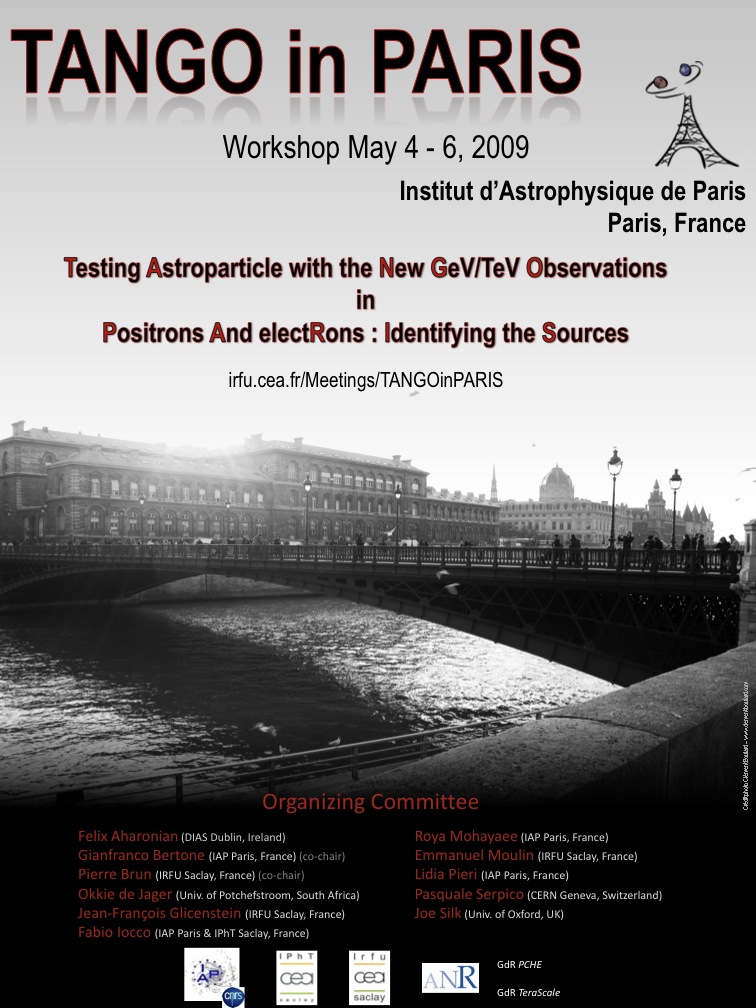
TANGO in Paris

Next week, we organize a small (80 participants) workshop at the Institut d’Astrophysique. The aim of the workshop is to discuss the new experimental results from PAMELA, ATIC, Fermi, HESS and to confront the possible interpretations. Specialists from cosmic rays physics, astrophysical sources of electrons and particle dark matter will debate their views of this cosmic leptons puzzle and discuss the future prospects.

You can check the schedule and find more information at
http://irfu.cea.fr/Meetings/tangoinparis/

Dark Matter in the Galaxy and elsewhere

Mattia Fornasa, Enzo Branchini, Lidia Pieri and I have been studying the flux and the angular power spectrum of gamma-rays produced by Dark Matter (DM) annihilations in the Milky Way (MW) and in extra-galactic halos.

The annihilation signal receives contributions from: a) the smooth MW halo, b) resolved and unresolved substructures in the MW, c) external DM halos at all redshifts, including d) their substructures. Adopting a self-consistent description of local and extra-galactic substructures, we have shown in a recent paper that the annihilation flux from substructures in the MW dominates over all the other components for angles larger than O(1) degrees from the Galactic Center, unless an extreme prescription is adopted for the substructures concentration.

We have also computed the angular power spectrum of gamma-ray anisotropies and found that, for an optimistic choice of the particle physics parameters, an interesting signature of DM annihilations could soon be discovered by the Fermi LAT satellite at low multipoles, l10^4 solar masses.